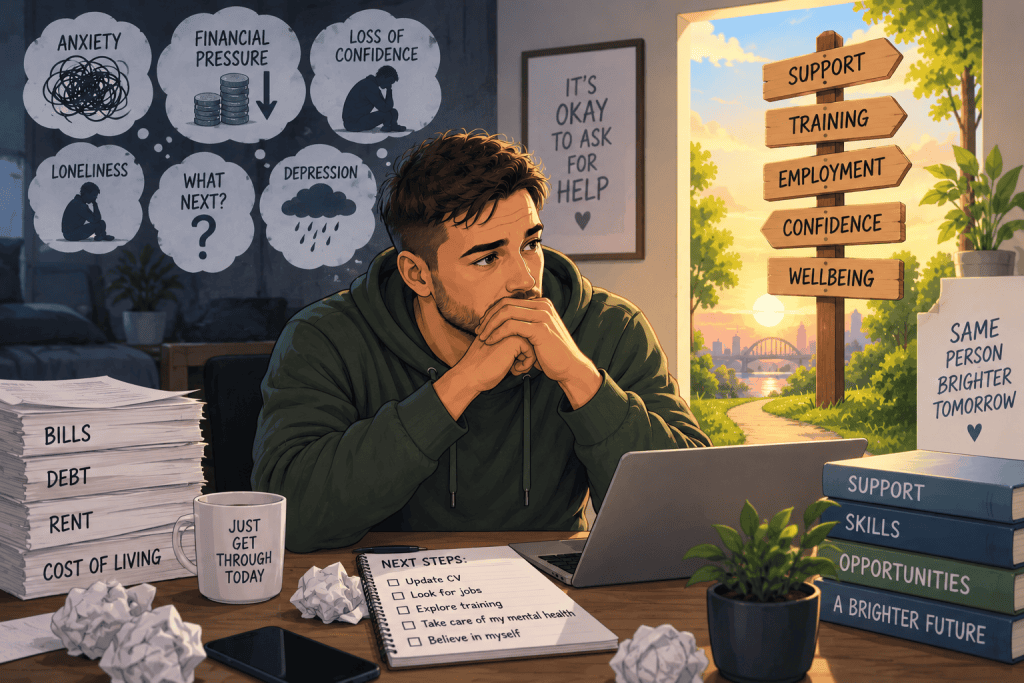
Unemployment can affect much more than income. Losing a job, being out of work for a long period, or struggling to find employment can have a significant impact on confidence, routine, relationships and mental wellbeing.
For some people, unemployment may lead to anxiety about money and the future. For others, it can contribute to depression, loneliness, low self-esteem and a loss of purpose. At the same time, existing mental health difficulties can make it harder to look for work, attend interviews or manage the pressures involved in returning to employment.
The connection between mental health and unemployment can therefore become a difficult cycle.
Understanding that connection is important because being unemployed does not define a person’s value, ability or future.
How Unemployment Can Affect Mental Health
Work can provide structure, social contact, routine and a sense of achievement.
When employment suddenly stops, these things may disappear at the same time.
A person may lose:
- Regular income
- Daily routine
- Contact with colleagues
- Confidence
- A sense of purpose
- Opportunities to develop skills
- Financial security
- Independence
This can create a major emotional adjustment.
Even when a person disliked their previous job, becoming unemployed can still affect their mental health because of the uncertainty and pressure that follows.
Anxiety and Unemployment
Unemployment can create ongoing worry.
People may become anxious about:
- Paying bills
- Rent or mortgage costs
- Finding another job
- Supporting their family
- Attending interviews
- Explaining gaps in employment
- Losing confidence or skills
- What other people think
These worries can become difficult to switch off.
Someone may find themselves repeatedly checking job websites, worrying late at night or imagining the worst possible outcome.
Long-term stress can also cause physical symptoms such as headaches, muscle tension, poor sleep, stomach problems and exhaustion.
The longer unemployment continues, the more intense these worries may become.
Depression and Being Out of Work
Unemployment can also contribute to depression.
People may begin to feel that they are no longer useful or that their situation will never improve.
They may lose motivation and stop enjoying activities they once liked.
Without the structure of work, days can begin to feel repetitive and empty.
Signs that unemployment may be affecting your mood include:
- Persistent sadness
- Low motivation
- Loss of interest in activities
- Sleeping too much or too little
- Withdrawing from other people
- Feeling worthless
- Poor concentration
- Irritability
- Hopelessness about the future
When depression develops, job searching can become even harder.
This can create a cycle where unemployment worsens mental health and poor mental health makes returning to work more difficult.
The Impact on Confidence and Self-Esteem
Many people connect their identity with their work.
Questions such as “What do you do?” are common in everyday conversations, and employment can become closely tied to how people see themselves.
When a job ends, confidence can take a serious knock.
Someone may begin thinking:
“I’m not good enough.”
“Nobody will employ me.”
“I’ve fallen behind.”
“Everyone else is doing better than me.”
These thoughts can feel very real, but unemployment can happen for many reasons that have nothing to do with someone’s ability.
Redundancy, business closures, illness, caring responsibilities, economic conditions and changes in an industry can all affect employment.
Being out of work does not erase your skills, experience or personal value.
Financial Pressure and Mental Health
One of the biggest challenges associated with unemployment is financial stress.
A reduction in income can make everyday life much harder.
People may worry about food, energy bills, travel costs, debt and housing.
Financial pressure can also affect relationships, particularly if one household suddenly has to manage on less money.
People may feel ashamed to tell friends they cannot afford social activities or become reluctant to ask for help.
This can lead to further isolation.
If unemployment has caused financial difficulties, it may help to seek benefits advice, debt support or help with budgeting as early as possible.
Practical support can reduce some of the uncertainty and give you a clearer understanding of your options.
Unemployment and Social Isolation
Work is a major source of social contact for many people.
When employment ends, daily interactions with colleagues can disappear overnight.
Someone may spend increasing amounts of time alone.
They may stop leaving the house regularly or avoid social situations because they feel embarrassed about being unemployed.
This isolation can worsen anxiety and depression.
Maintaining social contact is therefore important.
This could involve:
- Meeting friends
- Attending community groups
- Volunteering
- Exercising with others
- Joining training courses
- Taking part in peer-support groups
Volunteering can be particularly useful because it can provide routine, confidence, social contact and new experience while you continue looking for work.
The Effect of Mental Health Problems on Employment
The relationship between unemployment and mental health works both ways.
Some people become unemployed because mental health difficulties make it difficult to continue working.
Anxiety may make certain environments overwhelming.
Depression may affect concentration, motivation and attendance.
Trauma can make crowded or stressful workplaces difficult to manage.
Other people may leave work because of burnout, bullying or an unhealthy working environment.
Returning to employment after a period of poor mental health can feel daunting.
You may worry about whether you will cope or whether employers will understand.
Gradual support, counselling, volunteering or training can help rebuild confidence before returning to work.
Creating Routine When You Are Unemployed
When there is no workplace schedule, it can be easy for routine to disappear.
Sleep patterns may change and days can begin to blend together.
Creating your own structure can support mental wellbeing.
Try to maintain a regular time for:
- Getting up
- Eating meals
- Job searching
- Exercise
- Household tasks
- Relaxation
- Social contact
You do not need to spend every waking hour looking for work.
Constant job searching can increase stress and make rejection feel even more overwhelming.
Setting aside specific times for applications and then doing something different can help protect your mental health.
Coping With Job Rejection
Job rejection can be difficult, particularly when you have already experienced several unsuccessful applications.
It is easy to take rejection personally.
But many vacancies receive large numbers of applications, and rejection does not necessarily mean that you were unsuitable or lacking in ability.
Try to focus on what you can learn from each experience.
If possible, ask for feedback.
Review your CV.
Practise interview skills.
Consider whether additional training could strengthen future applications.
Most importantly, avoid treating each rejection as proof that you will never find work.
Job searching often involves setbacks before the right opportunity appears.
How Counselling Can Help
Counselling can provide emotional support during unemployment.
A counsellor cannot guarantee employment, but they can help you manage the psychological impact of being out of work.
Counselling may help you:
- Manage anxiety
- Improve confidence
- Challenge negative thinking
- Cope with rejection
- Deal with financial stress
- Develop healthier routines
- Explore workplace trauma
- Build resilience
- Prepare emotionally for returning to work
For some people, counselling alongside practical employment support can be particularly helpful.
Mental wellbeing and employment do not need to be treated as completely separate issues.
Taking Small Steps Towards Employment
Returning to work does not always need to happen in one large step.
For someone whose confidence has been affected, smaller steps can be more manageable.
This might include:
- Updating your CV
- Attending a training course
- Volunteering
- Speaking to an employment adviser
- Practising interview questions
- Applying for one or two suitable jobs
- Improving digital skills
- Exploring a different career
Progress is still progress, even if it is gradual.
Building confidence before returning to employment can improve the chances of maintaining that employment long term.
Mental Health and Employment Support From Anxious Minds
At Anxious Minds, we understand that unemployment, financial pressure and mental health difficulties are often closely connected.
We provide accessible counselling and mental health support for people experiencing anxiety, depression, stress, trauma, low confidence and other emotional difficulties.
Our aim is to provide a safe and supportive environment where people can talk openly about what they are experiencing, rebuild confidence and begin moving forward.
Being unemployed does not mean you have failed.
Sometimes people need support, time and the right opportunity to regain their confidence and direction.
If unemployment is affecting your mental health, talking to somebody can be an important first step.
Find out more about counselling and mental health support from Anxious Minds at www.anxiousminds.co.uk.
If you or somebody else is in immediate danger or there is an immediate risk of serious harm, call 999 or go to your nearest Accident & Emergency department.