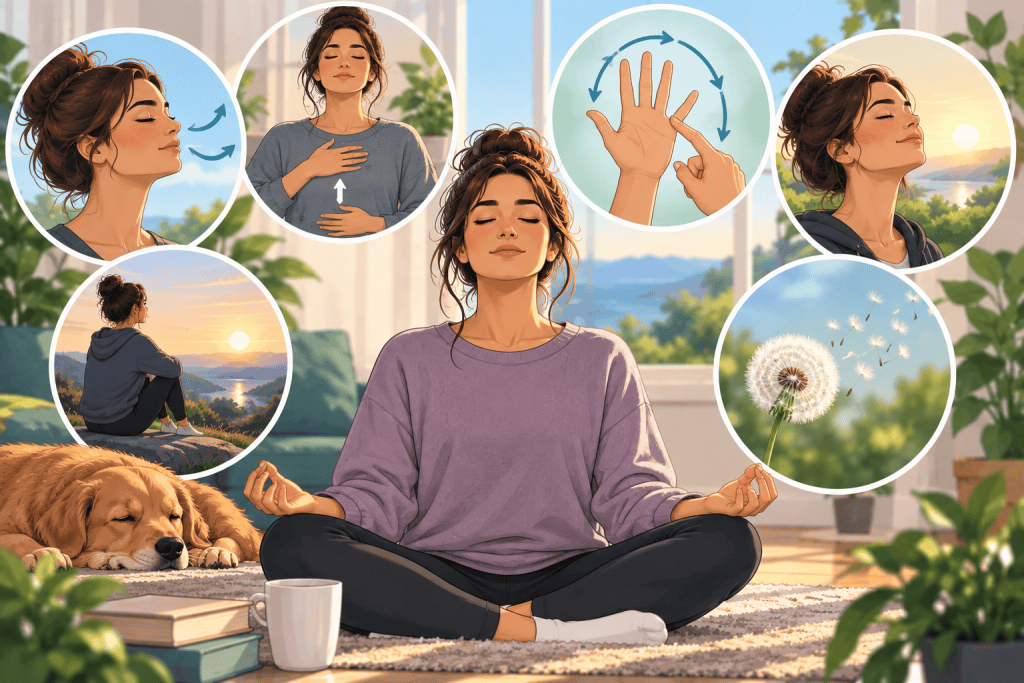
Anxiety can affect both the mind and the body. When you feel anxious, your breathing may become faster and shallower, your heart may race, your muscles may tense, and your thoughts may feel difficult to control.
One simple way to reduce these physical symptoms is through breathing techniques for anxiety.
Breathing exercises are not a cure for anxiety, but they can help calm the nervous system, reduce feelings of panic and give you something practical to focus on when your thoughts feel overwhelming.
The good thing about breathing techniques is that they can be used almost anywhere. You can practise them at home, at work, before an appointment, while travelling, or during a moment of rising anxiety.
Why Anxiety Affects Your Breathing
When the brain believes there is danger, the body can trigger its natural stress response.
Your heart rate may increase, your muscles may tighten and your breathing may become quicker.
This response is useful when there is a genuine threat, because it prepares the body to react quickly.
The difficulty is that anxiety can trigger the same response even when there is no immediate physical danger.
For example, worrying about work, finances, relationships, health or an upcoming appointment can cause your body to behave as though you need to escape from something.
Rapid breathing can then make you feel even more anxious.
You may experience:
- Dizziness
- Tingling
- Tightness in the chest
- Light-headedness
- A racing heartbeat
- Feeling unable to catch your breath
Slowing your breathing can help send the body a message that it is safe to settle.
1. Slow Breathing for Anxiety
One of the simplest breathing exercises is to deliberately slow your breathing.
Sit comfortably and relax your shoulders.
Breathe in gently through your nose.
Then breathe out slowly.
Try not to force the breath or take very large breaths.
The aim is simply to make each breath calm and steady.
You might breathe in for around four seconds and breathe out for around five or six seconds.
A slightly longer out-breath can help encourage relaxation.
Continue for a few minutes.
If counting makes you more anxious, forget the numbers and simply focus on breathing slowly.
2. Box Breathing
Box breathing is a simple technique that gives your mind a clear pattern to follow.
It involves four stages:
- Breathe in slowly.
- Hold the breath briefly.
- Breathe out slowly.
- Pause before breathing in again.
Some people use a count of four for each stage.
For example:
Breathe in for four.
Hold for four.
Breathe out for four.
Pause for four.
Then repeat.
The counting can help interrupt racing thoughts and bring your attention back to the present moment.
If holding your breath feels uncomfortable, shorten the pause or use another technique instead.
Breathing exercises should feel calming rather than restrictive.
3. Longer Exhale Breathing
When people feel anxious, they often focus on taking deep breaths in.
However, slowing the breath out can be particularly useful.
Try breathing in gently for a count of four and breathing out for a count of six.
Do not push the air out forcefully.
Let the breath leave naturally and slowly.
Repeat several times.
This technique can be useful before:
- A difficult conversation
- A medical appointment
- A job interview
- A counselling session
- Public speaking
- Going into a crowded place
It can also be useful at bedtime if anxiety is making it difficult to switch off.
4. Belly Breathing
When people are stressed, breathing can become shallow and concentrated in the upper chest.
Belly breathing, sometimes called diaphragmatic breathing, encourages a slower breathing pattern.
Place one hand gently on your chest and the other on your stomach.
Breathe in slowly through your nose.
Try to notice your stomach rising slightly as you breathe in.
Then breathe out gently and feel it fall.
Your chest may still move, but try to keep the breathing relaxed rather than lifting your shoulders.
You do not need to take huge breaths.
Slow, comfortable breathing is the goal.
Practising this when you are already calm can make it easier to use when anxiety increases.
5. Breathing With Grounding
Breathing exercises can work well alongside grounding techniques.
Grounding helps bring your attention away from frightening thoughts and back towards what is happening around you.
Try taking one slow breath and then noticing something you can see.
Take another breath and notice something you can hear.
Take another and notice something you can physically feel, such as your feet touching the floor or your hands resting on your knees.
This can be particularly helpful if anxiety is making you feel detached, overwhelmed or trapped inside your thoughts.
Breathing Techniques for Panic Attacks
During a panic attack, breathing may feel very difficult.
People sometimes believe they are going to faint, lose control or stop breathing.
The symptoms can feel frightening, even when they are caused by the body’s stress response.
During a panic attack, try not to force yourself to take enormous breaths.
Instead, aim for slow and gentle breathing.
Focus particularly on a steady out-breath.
You might silently tell yourself:
“Slow in.”
“Slow out.”
Keep your feet on the ground if possible and focus on something stable in the environment around you.
If you regularly experience panic attacks, it is worth speaking to a GP or mental health professional.
Breathing techniques can help manage symptoms, but repeated panic attacks may benefit from additional support.
When Should You Practise Breathing Exercises?
Breathing exercises are often easier to use during anxiety if you have practised them beforehand.
You do not need to wait until you are feeling overwhelmed.
Try practising for a few minutes when you are calm.
This might be:
- In the morning
- Before bed
- During a lunch break
- After work
- Before leaving the house
Regular practice can make the techniques feel more familiar.
Then, when anxiety begins to rise, your body already knows the routine.
Common Mistakes With Anxiety Breathing Exercises
One common mistake is breathing too deeply or too quickly.
When someone tells you to “take a deep breath,” it can be tempting to repeatedly pull in large amounts of air.
For some people, this can actually make dizziness or light-headedness worse.
Think about breathing slower, not necessarily bigger.
Another mistake is expecting the technique to remove anxiety immediately.
Breathing exercises may reduce the intensity of anxiety, but they may not eliminate every anxious thought.
That is okay.
The goal is to help your body become calmer so that you are better able to manage what you are experiencing.
Breathing Is a Tool, Not the Whole Solution
Breathing techniques can be extremely useful, but anxiety often has deeper causes.
If you are experiencing ongoing anxiety, it may be helpful to look at what is contributing to it.
This could include:
- Stress
- Trauma
- Financial worries
- Relationship difficulties
- Work pressures
- Low confidence
- Health concerns
- Grief
- Major life changes
Counselling can help you explore these issues rather than only managing the physical symptoms.
How Counselling Can Help With Anxiety
Counselling provides a safe and confidential environment where you can talk about what is causing your anxiety.
A counsellor can help you identify triggers, understand patterns in your thoughts and develop healthier ways of coping.
Support may help you:
- Understand why anxiety develops
- Challenge unhelpful thoughts
- Reduce avoidance
- Improve confidence
- Manage stress
- Develop grounding techniques
- Process difficult experiences
- Build healthier routines
Breathing exercises can then become one tool within a much wider approach to managing anxiety.
When to Seek Professional Support
It may be time to ask for help if anxiety is affecting your:
- Sleep
- Work
- Relationships
- Confidence
- Physical health
- Social life
- Ability to leave the house
- Everyday responsibilities
You do not need to wait until anxiety becomes unbearable.
Speaking to your GP or a qualified mental health professional can help you understand what support may be appropriate.
If you experience new or severe chest pain, serious breathing difficulties or symptoms you believe may be a physical emergency, seek appropriate medical help rather than assuming anxiety is the cause.
Anxiety Support From Anxious Minds
At Anxious Minds, we provide accessible counselling and mental health support for people experiencing anxiety, depression, trauma, bereavement, stress and other emotional difficulties.
Our aim is to give people practical tools alongside a safe place to talk about what is happening in their lives.
Breathing exercises can be a useful first step when anxiety begins to rise.
They can help you slow down, reconnect with the present moment and reduce some of the physical symptoms of stress.
But you do not have to manage ongoing anxiety by yourself.
Find out more about counselling and mental health support from Anxious Minds at www.anxiousminds.co.uk.
If you or somebody else is in immediate danger or there is an immediate risk of serious harm, call 999 or go to your nearest Accident & Emergency department.