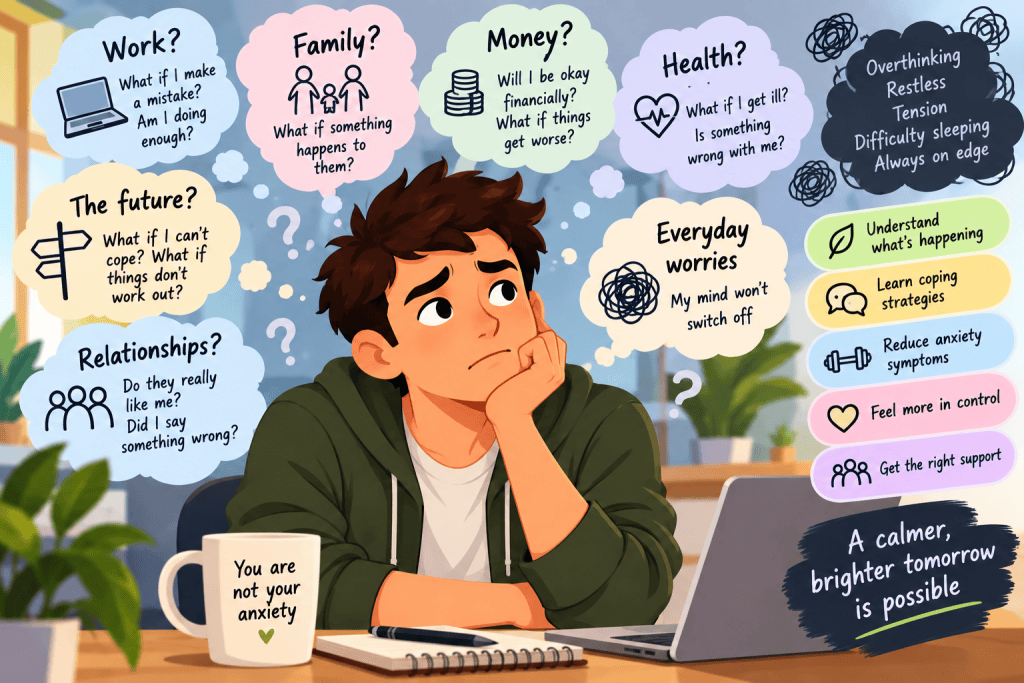
Generalised Anxiety Disorder, often shortened to GAD, is a common mental health condition that causes persistent and excessive worry about many different areas of life.
Everyone worries from time to time.
You may worry about money, work, relationships, family, health or something coming up in the future. In most cases, those worries come and go and are linked to a particular situation.
With Generalised Anxiety Disorder, worry can feel much harder to control.
It may move from one subject to another.
You might wake up worrying about work, then begin worrying about your health, then your family, then money, then something you said several days ago.
Even when one worry is resolved, another can quickly take its place.
At Anxious Minds, we support people experiencing anxiety and other mental health difficulties. We know that GAD can be exhausting, especially when other people do not understand why someone cannot simply “stop worrying.”
Understanding Generalised Anxiety Disorder is an important step towards getting the right support.
What Is Generalised Anxiety Disorder?
Generalised Anxiety Disorder is a condition where anxiety and worry become frequent, persistent and difficult to manage.
The worry is often spread across several parts of life rather than being focused on one specific fear.
Someone with GAD may worry about:
- Their job
- Finances
- Their health
- Their family’s wellbeing
- Relationships
- Everyday responsibilities
- Future events
- Making mistakes
- Being judged
- Things that may never happen
The worrying can feel relentless.
Someone may understand logically that their worries are excessive, but that does not mean they can simply switch them off.
This is one of the reasons GAD can feel so frustrating.
You may know you are overthinking, but still feel unable to stop.
What Does Generalised Anxiety Disorder Feel Like?
People experience GAD differently.
For some, the main problem is constant overthinking.
For others, physical symptoms can be just as difficult.
A person may feel as though their mind is permanently scanning for the next problem.
Thoughts might include:
“What if something goes wrong?”
“What if I make a mistake?”
“What if I lose my job?”
“What if someone I love gets ill?”
“What if I cannot cope?”
The mind keeps asking “what if?”
Even during calm periods, the person may struggle to relax because part of them feels that something could go wrong at any moment.
This constant state of alertness can become mentally and physically exhausting.
Common Symptoms of Generalised Anxiety Disorder
GAD can affect both the mind and the body.
Psychological symptoms may include:
- Excessive worrying
- Difficulty controlling worry
- Overthinking
- Difficulty concentrating
- Feeling constantly on edge
- Irritability
- Restlessness
- Difficulty relaxing
- Fear that something bad is going to happen
- Repeatedly seeking reassurance
Physical symptoms may include:
- Muscle tension
- Headaches
- Tiredness
- Difficulty sleeping
- Feeling shaky
- Sweating
- Stomach problems
- Nausea
- Rapid heartbeat
- Feeling short of breath
- Dizziness
- Jaw clenching
Not everyone will experience all of these symptoms.
The severity can also change depending on stress levels and what is happening in somebody’s life.
Why Does GAD Cause So Much Worry?
The brain is designed to identify possible threats.
This is useful when genuine danger is present.
But anxiety can make the brain behave as though everyday uncertainty is a threat.
Someone with GAD may constantly try to predict and prevent negative outcomes.
The mind may think:
“If I worry enough, I will be prepared.”
“If I think through every possibility, I can stop something bad happening.”
“If I stay alert, I will not be caught off guard.”
This can make worrying feel almost protective.
But instead of making someone feel safe, it often creates more anxiety.
The brain becomes trained to look for problems.
The more problems it searches for, the more it finds.
What Causes Generalised Anxiety Disorder?
There is no single cause of GAD.
For many people, several factors may be involved.
These can include:
- Genetics
- Personality
- Previous difficult experiences
- Chronic stress
- Trauma
- Family environment
- Major life changes
- Financial problems
- Relationship difficulties
- Workplace stress
- Physical health concerns
Some people may be naturally more sensitive to uncertainty or risk.
Others may have experienced situations that taught them to remain constantly alert.
For example, someone who grew up in an unpredictable or stressful environment may become used to looking for signs that something could go wrong.
However, not everyone with GAD can identify a clear reason why it developed.
You do not need to understand exactly where your anxiety came from before you can begin working on it.
How GAD Affects Everyday Life
Generalised Anxiety Disorder can have a significant impact on day-to-day life.
Because the anxiety can affect many areas at once, it can become difficult to switch off.
GAD and Work
Someone may constantly worry about performance.
They may repeatedly check emails, paperwork or tasks because they are afraid of making mistakes.
They may spend hours thinking about a conversation with a manager or colleague.
Even when they receive positive feedback, they may worry that they have overlooked something.
This can make work mentally exhausting.
GAD and Relationships
Anxiety can create repeated doubts about relationships.
Someone may wonder whether their partner is upset, whether friends truly like them or whether they have said something wrong.
They may seek reassurance frequently.
This can be tiring for both the person with anxiety and the people around them.
GAD and Sleep
Worry often becomes particularly noticeable at night.
During the day, work and responsibilities may provide distractions.
At night, when everything becomes quiet, the mind may begin reviewing problems.
Someone may lie awake thinking about tomorrow, next week or situations that may never happen.
Poor sleep can then increase anxiety the following day.
The Physical Impact of Constant Anxiety
GAD is not just something that happens in the mind.
When the body remains in a prolonged state of stress, physical symptoms can develop.
Muscles may remain tense.
Breathing may become shallow.
The heart may beat faster.
Digestion may be affected.
Someone may feel tired even after sleeping because their nervous system has been working hard.
This can sometimes cause people to worry about their physical health, which may create another source of anxiety.
If you develop new or unexplained physical symptoms, it is important to seek appropriate medical advice rather than assuming anxiety is the cause.
GAD and Overthinking
Overthinking is one of the most common experiences associated with Generalised Anxiety Disorder.
Someone may repeatedly analyse situations.
They might replay conversations and ask:
“Did I sound rude?”
“Should I have said something differently?”
“What did they mean by that?”
“Why haven’t they replied?”
The person may feel that if they analyse the situation long enough, they will eventually reach certainty.
But complete certainty is rarely possible.
This can result in hours of rumination without any real resolution.
GAD and Reassurance-Seeking
People with GAD sometimes ask other people for reassurance.
They may repeatedly ask:
“Do you think everything will be okay?”
“Are you sure I didn’t do anything wrong?”
“Do you think they are angry with me?”
Reassurance can reduce anxiety temporarily.
But if the worry returns, more reassurance may be needed.
Over time, this can become a cycle.
Learning to tolerate uncertainty can therefore become an important part of managing anxiety.
Can Generalised Anxiety Disorder Be Treated?
Yes.
Many people learn to manage GAD effectively.
Treatment and support will depend on the individual, but options may include psychological therapies, lifestyle changes and, for some people, medication.
A GP or qualified mental health professional can discuss the options available.
Recovery does not necessarily mean never worrying again.
Worry is a normal part of being human.
The aim is often to reduce anxiety to a level where it no longer dominates everyday life.
How Counselling Can Help With GAD
Counselling can provide a safe space to explore anxiety without judgement.
A counsellor may help you understand:
- What triggers your anxiety
- How your thoughts influence your emotions
- Patterns of avoidance
- Reassurance-seeking
- How stress affects your body
- How previous experiences may influence current worries
- Healthier ways to respond to uncertainty
For some people, Cognitive Behavioural Therapy, or CBT, may be particularly helpful.
CBT focuses on the relationship between thoughts, feelings and behaviours.
It can help people identify unhelpful thinking patterns and develop alternative ways of responding.
Different approaches work for different people, and support should always be tailored to individual needs.
Practical Ways to Manage Generalised Anxiety Disorder
There are several strategies that may help alongside professional support.
Recognise Worry Patterns
Try noticing when worry starts.
Ask yourself:
“What am I worrying about?”
“Is this something I can act on now?”
If the answer is yes, consider one practical step.
If the answer is no, recognise that continued worrying may not solve the situation.
Limit Repetitive Checking
Repeatedly checking emails, messages, locks, finances or other things can strengthen anxiety.
Where appropriate, gradually reducing checking behaviours can help.
Build Healthy Routines
Regular sleep, exercise, meals and time outdoors can support the nervous system.
These habits will not cure anxiety, but they can create a more stable foundation.
Reduce Excessive Caffeine
Caffeine can increase physical symptoms such as a racing heart, shakiness and restlessness.
For some people, reducing caffeine may help lower anxiety.
Practise Grounding
If your mind becomes trapped in future worries, focus on the present.
Notice what you can see, hear and feel.
Bring your attention back to what is actually happening right now.
Why Avoidance Can Make GAD Worse
Anxiety often encourages people to avoid situations they believe may cause stress.
This can feel helpful in the short term.
But avoidance may teach the brain that the situation was genuinely dangerous.
Over time, this can reduce confidence.
Someone may avoid meetings, travel, social situations or new experiences.
Gradually facing manageable situations can help rebuild confidence.
This is often easier with appropriate professional guidance.
When Should You Seek Help?
Consider seeking support if anxiety is affecting:
- Your sleep
- Your work
- Your relationships
- Your physical health
- Your ability to relax
- Your confidence
- Your ability to enjoy life
You do not need to wait until anxiety becomes unbearable.
If worrying is consuming large parts of your day, professional support may help you understand what is happening and begin making changes.
Supporting Someone With GAD
If somebody you care about has Generalised Anxiety Disorder, try to be patient.
Avoid saying:
“Stop worrying.”
“There is nothing to worry about.”
“Just relax.”
If it were that easy, they would already be doing it.
Instead, you might say:
“I can see this is really difficult for you.”
“Do you want to talk about what is worrying you?”
“How can I support you?”
Listening can be more helpful than immediately trying to solve every problem.
You Are Not Your Anxiety
Living with GAD can make it feel as though worry is part of your personality.
You may think:
“I have always been like this.”
But anxiety is not your identity.
It is a pattern of thoughts, emotions and physical responses that can be understood and managed.
With support, people can learn to spend less time preparing for everything that might go wrong and more time engaging with what is actually happening in their lives.
Anxious Minds Is Here to Help
At Anxious Minds, we support people experiencing anxiety, depression, trauma and other mental health difficulties.
If constant worry is affecting your everyday life, you do not have to manage it alone.
Counselling and mental health support can help you understand your anxiety, recognise unhelpful patterns and develop healthier ways of coping.
Anxious Minds
Telephone: 0191 262 0305
If you or somebody else is in immediate danger or you believe you may act on thoughts of suicide or serious self-harm, call 999 or go to the nearest Accident & Emergency department.
Generalised Anxiety Disorder can make the future feel constantly threatening.
But with the right understanding and support, anxiety does not have to control your life.